When Scenes See Themselves: Mapping the Collective Consciousness of Culture
Why scene mapping?
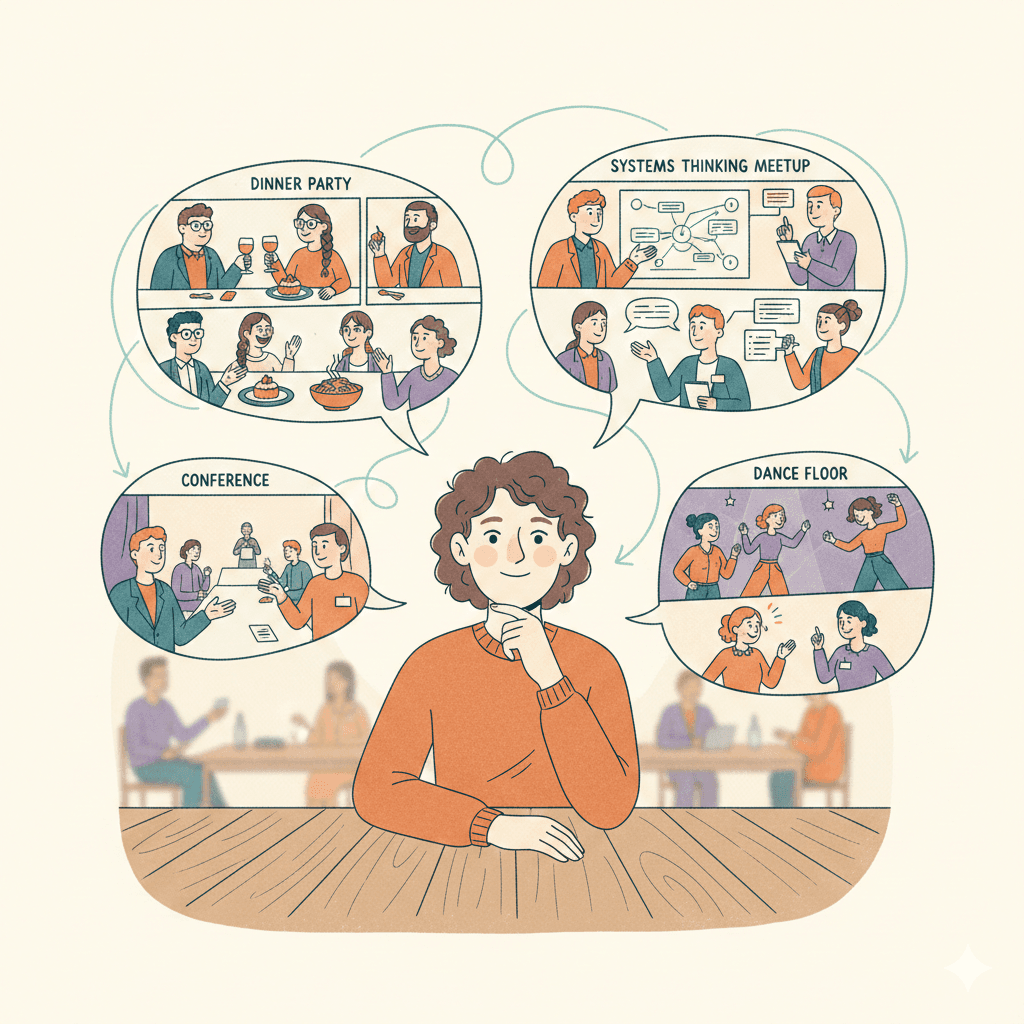
You're at a somatics workshop on a Wednesday night. Across the room, you spot someone from that systems thinking meetup last month. The facilitator? They were at the regenerative economics dinner. And wait — isn't that the person who hosted the collaboration session inspired by mycelium networks?
For a moment, you wonder if you're imagining patterns that aren't there. But then it keeps happening. Different venues, different topics, same faces. You start to notice shared language appearing in disparate places — people using similar metaphors, similar ways of being together. It's like watching constellation patterns emerge in the night sky.
You're not imagining it. You've stumbled into something alive.
What Makes a Scene?
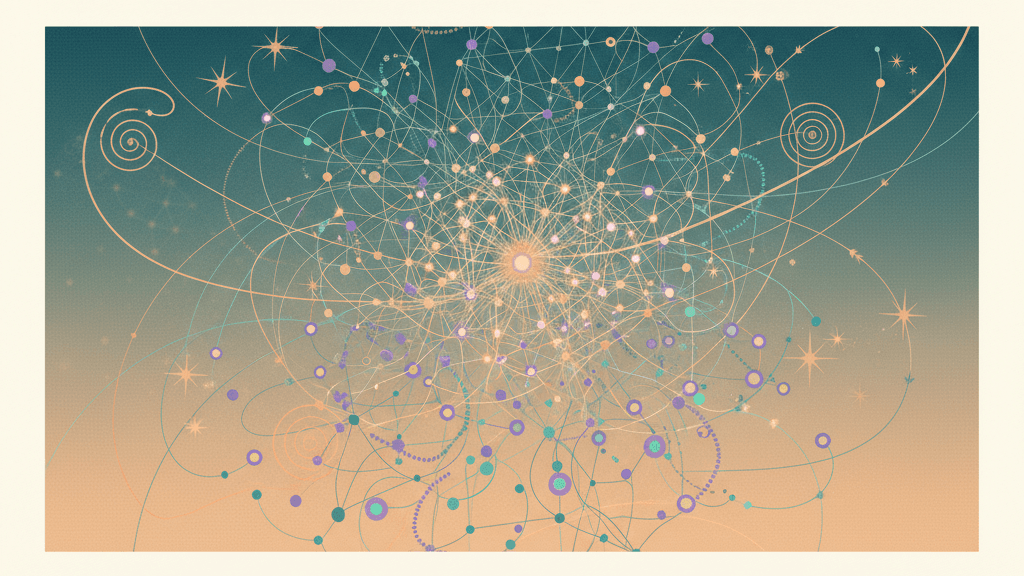
This isn't just a network. Networks have formal relationships — LinkedIn connections, organizational charts, trade associations. This isn't just a community either. Communities tend to have clearer centers, more defined boundaries around shared identities or practices.
A scene is something more fluid and more coherent at the same time. It's what happens when culture becomes visible enough to recognize but distributed enough that no one owns it. It's the ska scene in Montreal in the 2000s. It's the rise of Silicon Valley as a tech hub. It's what's emerging in Toronto right now around people who care about growth, healing, and systems change.
Signs you're in a scene:
- You keep bumping into the same people at wildly different events
- Similar vibes and language appear across different spaces
- It's not centered in any one place — it's held by many
- People can tell who's in it and who isn't, even without explicit membership
A scene has an attractor — something that pulls elements together, even if it's never been formally named. This is different from a boundary that defines who's in or out. Instead, people resonate with the attractor at different intensities. Some are at the core, some orbit the edges, some drift between multiple scenes.
The Magic of Seeing
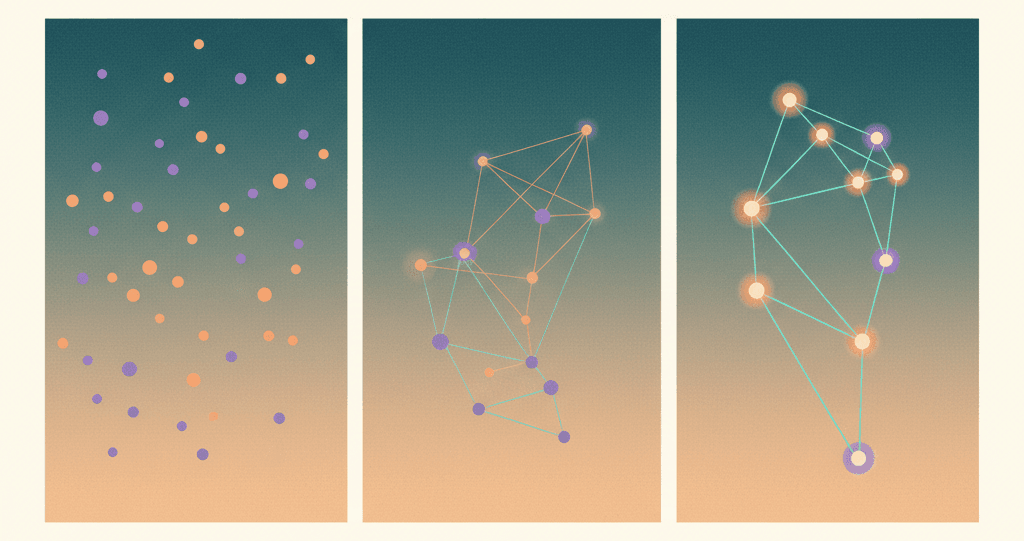
Here's where it gets interesting. In Toronto, my collaborator Meghan Hellstern and I released a social systems map into what we felt to be an emerging scene. We expected to find distinct subgroups — event creators in one cluster, tech innovators in another, healing practitioners over here. What we found surprised everyone who joined.
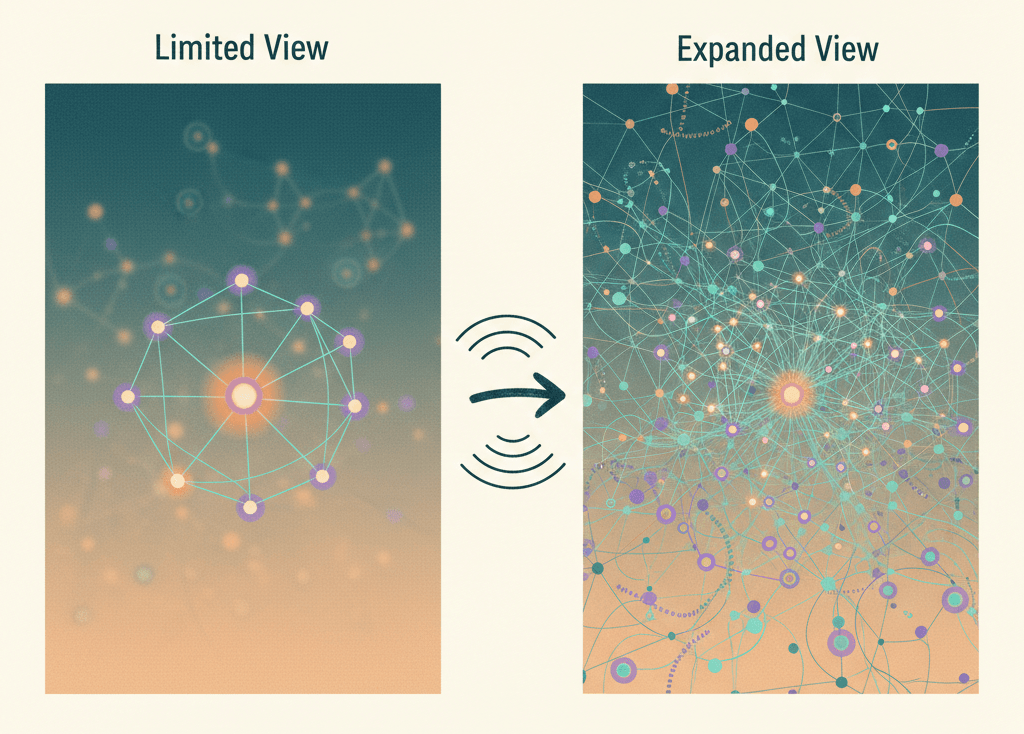
Over 200 people mapped themselves, revealing their connections, interests, and dreams for this network. When we visualized it, the automatic community detection algorithm found just one community, not the 20+ we'd seeded. People were shocked to see how many folks they knew from completely different contexts, all woven into the same web.
Something shifted when people could see the whole. Questions became possible that couldn't be asked before:
- "Who are we?"
- "What do we want?"
- "What is ours to do?"
- "How are we learning and evolving?"
- "What are our blindspots?"
Consciousness requires three things: awareness of self, awareness of environment, and awareness of the relationship between them. When a scene can see itself — when the parts can see each other and the whole — a quality of collective consciousness emerges. The parts start caring for the whole. The whole starts caring for the parts.
In Internal Family Systems therapy, just having one Part that is conscious — aware of the whole system and its context — can be enough to create a quality of consciousness for the entire person. The same pattern holds for scenes. If even a small web of individuals can see and describe the scene, they can act to support emergent qualities of consciousness in the larger system.
To someone unconscious of the larger pattern, it feels like magic: "This place just has so many coincidences that benefit me." To someone who sees the system, it's visible: the nudges, the connections, the conditions that make those coincidences probable.
The Developmental Journey of Scenes
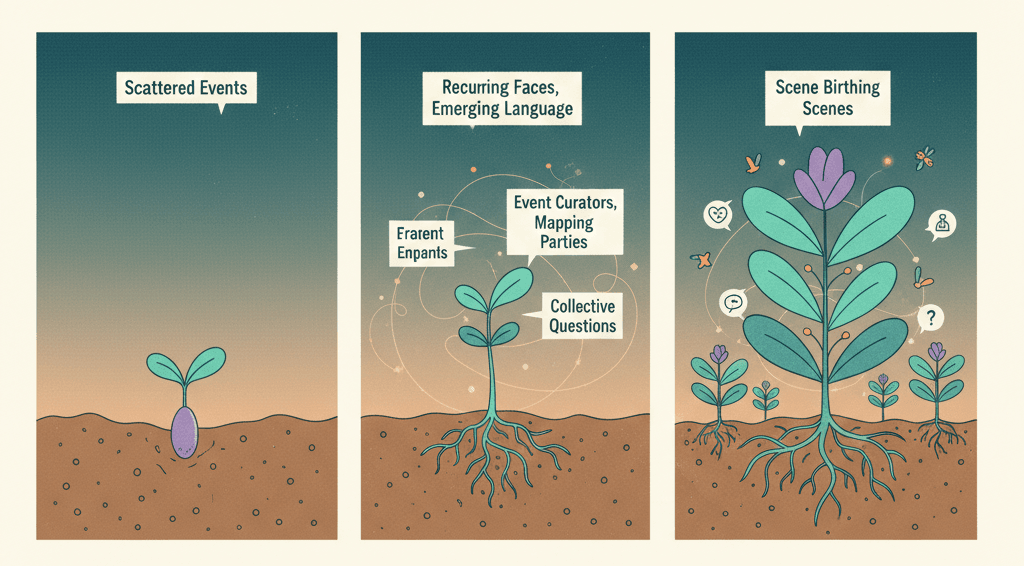
Not all scenes are created equal. Like individuals moving through stages of ego development, scenes grow in their capacity for collective consciousness and intentionality. To make up a fake framework:
Stage 1: The Emerging Scene
At this stage, people are starting to notice patterns. "Wait, something's happening here..."
Individual events occur. People attend things they're interested in. Occasionally someone says, "Hey, weren't you at that thing last week?" But there's no perception of a larger pattern yet. It's like a cloud or a crowd — low coherence, no sense of "we," no collective awareness or intentionality.
This is the atomistic stage. Each person pursues their individual interests. The scene exists objectively — you could draw the connections on paper — but it doesn't exist subjectively. No one has named it yet.
Stage 2: The Conscious Scene
This is where things get interesting. The scene becomes visible to itself.
Event creators start attending each other's events. Shared language and concepts begin circulating. People can name the vibe: "This feels like a [scene name] thing." The scene becomes mappable — people can visualize the whole, even if imperfectly.
Here's a key developmental marker: event curators emerge. Not just hosts creating individual events, but people who aggregate and make sense across events. They're operating at a layer of complexity higher than individual event creation. They see patterns. They connect dots. They help others discover related happenings.
The scene develops a sense of itself — collectively making sense of what's going on around it. It can respond to its environment. Collective questions become possible. There's intentionality, not just momentum.
"We are the people who care about growth, healing, and systems change in Toronto" — this kind of statement becomes sayable. The scene has a collective identity, even if loosely held.
Research on collective intelligence suggests that groups that develop real shared intelligence tend to have certain qualities in common: high social perceptiveness (people who can read subtle cues about what others are feeling), equal conversational turn-taking (not dominated by a few voices), and cognitive diversity (different ways of thinking and knowing). A conscious scene embodies these qualities not just in individual gatherings, but across its whole network. Information flows. Different perspectives are valued. There's space for novelty.
Stage 3: The Generative Scene
This is where scenius — Brian Eno's term for the collective genius of scenes — fully emerges.
The scene becomes capable of something profound: it can generate new scenes. Not just new events, but new event-generators. Not just community, but the conditions for community. It develops what we might call "sensing organs" — regular practices for collective awareness like mapping parties, reflection gatherings, and cross-pollination rituals.
The scene can hold developmental perspective on itself. It understands its own growth. It relates consciously to other scenes, creating channels for learning and mutual support. Care flows both ways — parts nurture the whole, and the whole nurtures the parts.
As Keith Sawyer writes in Group Genius, when groups achieve flow together, they blend egos while maintaining individual skill. There's a paradox: you must be highly competent AND willing to subordinate yourself to the collective intelligence. The scene becomes greater than the sum of its parts.
Donella Meadows, in her work on leverage points in systems, noted that the highest-leverage interventions are those that shift paradigms — or transcend them entirely. A generative scene operates at this level. It's not just doing things differently, it's changing what's possible to imagine.
Here, multiple attractors can be held simultaneously without fragmentation. The Toronto scene interested in growth might spawn a sub-scene focused on embodiment practices, another on collaborative governance, another on metamodern art. These remain connected to the parent scene while developing their own coherence. The scene becomes fractal — consciousness at every scale.
What Kills Scenius?
Before we talk about how to nurture scenes, let's be honest about what suffocates them:
- Premature institutionalization. Trying to capture and control the scene before it's ready. The moment someone says "we should make this official" with bylaws and membership criteria, something precious often dies. Structure is needed eventually, but timing matters enormously.
- Status hierarchies calcifying. When the scene becomes about who's "in" rather than what's emerging. When early participants gate-keep rather than welcome. When influence becomes currency to hoard rather than energy to circulate.
- Loss of porosity. When boundaries become walls. When people stop bringing friends from other contexts. When "you had to be there from the beginning" becomes the vibe.
- Extraction without reciprocity. People mining the scene for personal gain — contacts, opportunities, content — without giving back. This creates a vacuum, depleting rather than generative.
- Homogenization. When cognitive diversity collapses into conformity. When there's a "right way" to think or be. When novelty becomes threatening rather than exciting.
As Nora Bateson writes about symmathesy — mutual learning in living systems — health requires diversity in relationship. When contexts collapse into uniformity, learning stops. The scene becomes stagnant.
Conditions for Scenius
So what creates the conditions for scenes to flourish and evolve? Drawing from research and observation:
- Rapid exchange of ideas. Brian Eno emphasized this in his original articulation of scenius. Ideas must circulate quickly. This isn't just information transfer — it's inspiration cascading. You attend an event, get sparked, create your own version, which sparks someone else. Velocity matters.
- Mutual appreciation. "Scenius is like genius," Eno wrote, "only embedded in a scene rather than in genes." People genuinely celebrating each other's work. Stealing from each other generously. Building on each other's experiments without territorialism.
- Tolerance for novelty. Willingness to try weird things. Psychological safety to fail publicly. Spaces where half-baked ideas are welcomed. As Keith Sawyer notes in his research on group flow, operating at the edge of abilities — where failure is possible — is essential for breakthrough.
- Blending egos. Another insight from Sawyer: individuals must be skilled AND willing to subordinate themselves to collective emergence. It's not about ego death, but ego dance. Knowing when to lead, when to follow, when to get out of the way.
- Familiarity breeding improvisation. When people know each other's styles and rhythms, they can "yes-and" more fluidly. Like jazz musicians who've played together for years, there's an attunement that enables collective improvisation.
- Equal participation. This shows up in both Woolley's research on collective intelligence and Sawyer's on group flow. Domination by a few voices diminishes the whole. This doesn't mean everyone speaks the same amount, but that everyone's contribution matters and is invited.
- Network effects of cooperation. When helping others becomes the norm, when collaboration compounds. Otto Scharmer calls this "presencing" — the capacity of a system to sense and actualize its highest future potential. Scenes that cultivate this quality become generative engines.
The Practice of Mapping
So how do we support scene consciousness? How do we help scenes see themselves?
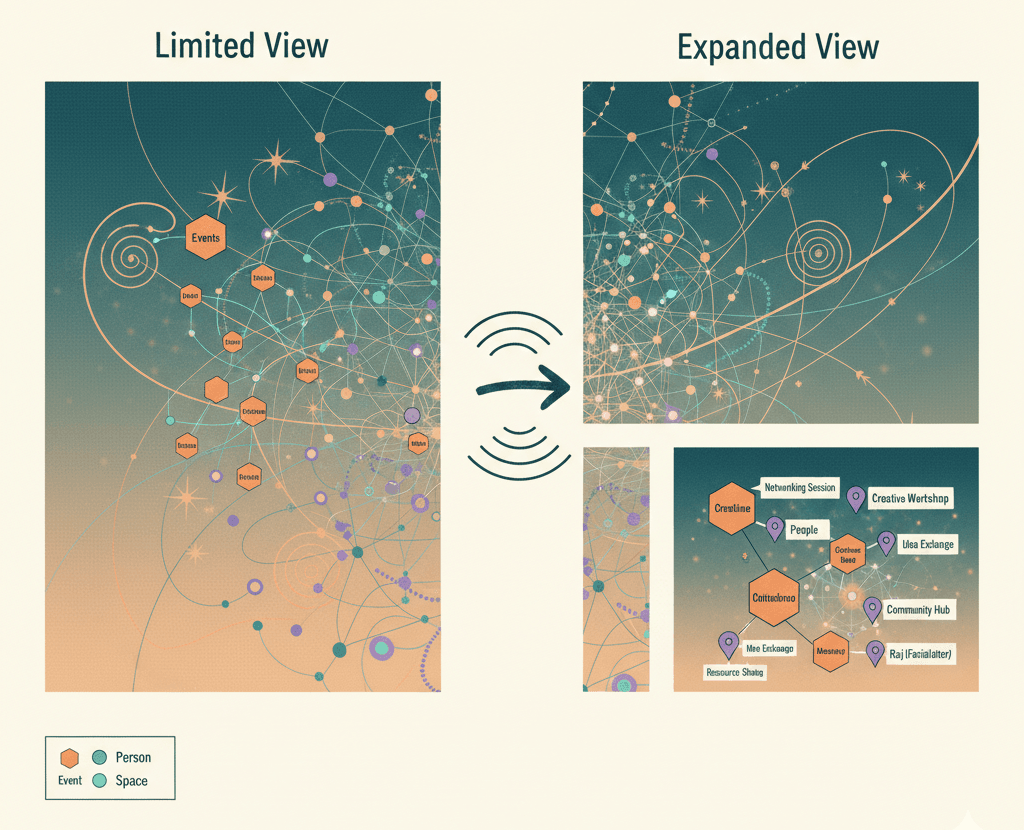
At SceneMapper.ca, we've been experimenting with participatory mapping. We map events, people, spaces, communities, meta-communities, and the connections between them. But the tool itself is less important than the practice.
Mapping parties bring together diverse people from across a scene. We invite them to map themselves — their connections, their interests, their dreams and questions for the network. The conversation that happens while people add themselves to the map is as valuable as the map itself. People discover surprising connections. They articulate patterns they'd felt but never named. They start to see their role in a larger ecology.
The map becomes a mirror. Not a perfect reflection — all maps are partial, all models are wrong — but useful. It makes the invisible visible enough to discuss, to wonder about, to act on.
As Dave Snowden teaches in his work on complexity and sense-making, we can't manage complex systems, but we can sense them and create conditions for desired patterns to emerge. Mapping is a sensing practice. It reveals where the energy is flowing, where bridges might be built, where gaps exist.
When we held our first mapping party for the Toronto scene, over 80 people showed up. The room buzzed with the particular quality of recognition — "Oh, you're the person who..." and "I had no idea you were connected to..." The map itself showed one highly interconnected web. But more important was what happened next: people started asking questions about the scene's future. They started proposing new collaborations. They started thinking as "we."
One conscious part awakening others.
Your Turn
If you're reading this, you're probably already embedded in at least one scene, whether you've named it or not. Maybe you're the person who keeps showing up at different gatherings and noticing the same faces. Maybe you're hosting events and wondering how they connect to the larger ecosystem. Maybe you're just curious why certain spaces feel different — more alive, more meaningful.
Consider this your invitation to look for the patterns. Who do you keep encountering across different contexts? What's the attractor that's pulling you all together, even if it's never been articulated? What shared language or ways of being have you noticed emerging?
And then consider: what would it take to help your scene see itself?
You don't need sophisticated tools or formal structures. Start with conversation. Host a gathering where the explicit purpose is to map the network. Create a simple form asking people to name the events they attend, the people they're connected to, the communities they're part of, what they dream about for the collective.
The practice of mapping itself is developmental. As people articulate their place in the web, as they see the larger pattern, something shifts. Questions become possible. Intentionality emerges. Care starts flowing in new directions.
You might discover, as we did in Toronto, that what felt like separate communities is actually one highly interconnected scene waiting to recognize itself. Or you might clarify important distinctions — this is separate from that, and that's okay. Either way, you'll know something you didn't before.
The world needs more conscious scenes. Not because scenes are inherently good — they can be insular, conformist, extractive if they develop poorly. But because the challenges we face require new forms of collective intelligence. We need to get better at working across differences, at generating novelty while maintaining coherence, at caring for wholes while honoring parts.
Scenes that can see themselves have a fighting chance at becoming scenes that can evolve themselves. And scenes that can evolve themselves might just be the cultural containers we need for the transition ahead.
As Nora Bateson writes, "The pattern which connects is a metapattern. It is a pattern of patterns." When scenes map themselves, they're not just documenting what is. They're participating in the pattern which connects. They're making evolution visible and therefore more possible.
So look around at your next event. Notice who's there. Ask someone how they found out about it. Start connecting dots. Begin the conversation.
Your scene is waiting to see itself.
Want to explore this further?
If you're working on scene-mapping, collective intelligence, or cultural evolution, I'd love to hear from you. Reach out on LinkedIn or Twitter.
And if you're in Toronto and this resonates, come to one of the events in our emerging scene. Check out the interactive map at SceneMapper.ca or browse upcoming gatherings.
The map is always growing. The scene is always evolving. Your presence matters.